
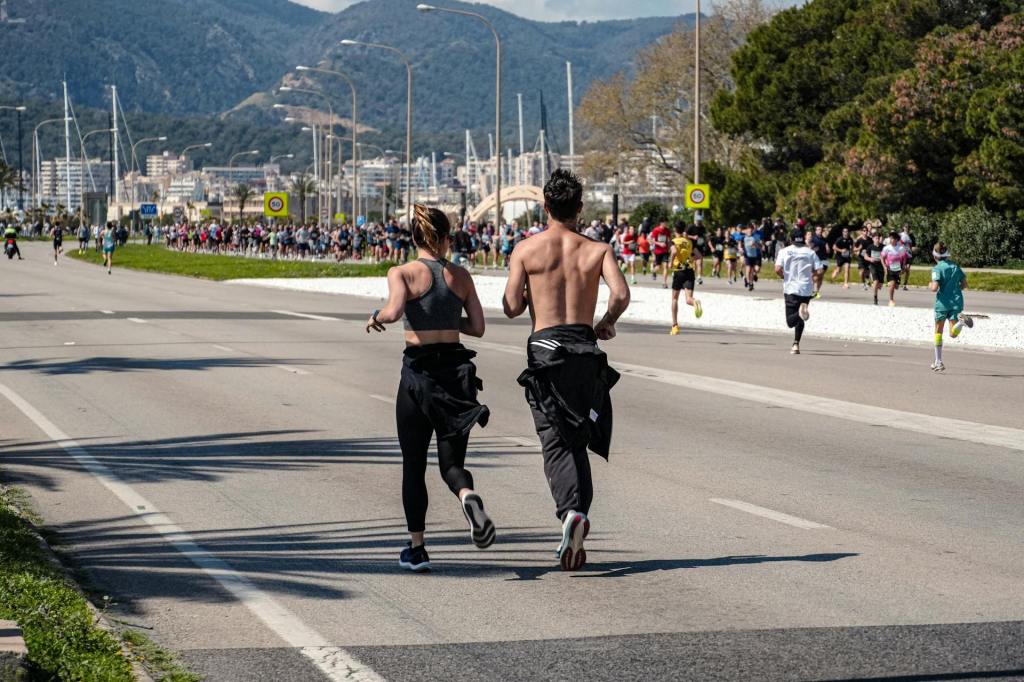
Somewhere around the first few kilometers of the Ironman marathon, after you swam like a hero and biked a ton of miles already, a question will pop up: “Perhaps we take a brief walk first, just to gather myself?”. You are, after all, very tired. You have been swimming, biking, thinking, and bargaining for hours. You deserve this. A few steps of walking would be civilized, humane even.
TLDR Watt I’ve Learned? Walking is not the enemy, but where you walk, and how you walk, matters more than most of the gear debates you had all year.
The smartest runners in long-course triathlon use the aid stations the way a pilot uses scheduled stops: briefly, deliberately, and with an exit plan. They may even slow to a brisk walk at the first table, take what they need, and then, before the body files a change-of-pace request with central command, they are running again. Fifteen to thirty seconds, perhaps a touch more in heat. The line between purposeful walking and default walking is thin. Cross it, and the marathon will take the pen from your hand and start writing the rest of the day for you. You think you lost a few minutes on your slower-than-usual swim? Be prepared to lose a few hours if you decide to start walking your marathon leg..
Why be so precious about a few meters? Because the body seems to learn fast, especially late in an Ironman. Once you walk past the aid station, your muscles will notice. Hip flexors tighten like doors on soft-close hinges. Cadence doesn’t merely drop; it vanishes, replaced by a shuffle that flatters neither speed nor dignity. Your nervous system, ever eager to conserve, decides that this new economy is the correct budget. Convincing it otherwise becomes an argument you must restart every time you slow down. That argument grows longer and less persuasive with each repetition.
The solution, is to keep moving at a run the moment the aid station is behind you. It doesn’t have to be pretty. In fact, in my experience, it won’t be. Even a slow jog carries a different signature than a walk. Those signals tell your body, this is what we’re doing. No walking.
This is easier to execute if you decide in advance. Before race day, script the aid station routine like choreography and then rehearse it in training. Grab, walk, sip, go. Pour water on your head only if heat management demands it; otherwise keep your shoes dry at all cost. If you need a gel that requires washing down with water, tear it as you arrive, swallow it as you walk, and chase it with water. And then, as you pass the last bin, transition back to a run.
Of course, there are exceptions. If you are dizzy, if your gut has closed for business (you didn’t forget those electrolytes, did you?), if cramps threaten to turn drama into injury, you are not in a discipline test; you are in a troubleshooting exercise. Walk while you solve the problem. But know the difference between solving a problem and indulging a preference. One has a plan and a clock. The other has a thousand excellent justifications that end, an hour later, in a finish line you could have reached sooner and prouder. Remember, more walking also means more time spent racing, that is not necessarily what you want even if the finishing time doesnt matter at all to you.
Pacing helps. If your bike leg was a story written in watts you hadn’t earned, the run will collect its debt with interest. Sensible cycling is a love letter to your future self at kilometer thirty-two. Any experienced triathlete most likely will have shared that insight with you. And don’t forget to eat on the bike, that’s where you can do your best fueling. Early on the run, start conservative enough that you feel almost silly. Let the course come to you. It is very easy to run too fast that first kilometer or two and it will only come back to bite you around the 20-30K mark.
The mind will try clever tricks, as it always does. It will propose a rhythm, run nine minutes, walk one. It will offer a reward structure, if you walk to that tree, you can run to the next aid station. Structured run–walk can absolutely be a legitimate strategy in ultras; in Ironman, it often becomes a slow erosion of intent. If you adopt intervals, make them part of your plan before the gun, not a treaty you sign with fatigue at mile sixteen.
None of this is a moral stance. Walking is not failure. You are allowed all the gaits you need to finish. But if your goal is to run the marathon, then treat running as the default and walking as a tool used in narrow, deliberate windows. Spend it wisely and it will pay you back in minutes saved and pride intact.
Watt I Learned
Walking the aid stations made me more efficient, cleaner hydration, fewer stomach mishaps, less chaos, no sticky sugary drinks dripping down my legs into my shoes, causing insane blisters… but walking beyond them made the marathon feel longer and slower every single time. Once I let myself stroll between tables, my body took it as permission to downgrade the whole enterprise. The fix was deciding, before the race, that the last trash can at each station was my run-switch. Grab what I needed, manage heat, and then jog, no matter how slow or ugly, until the next station. When I kept that promise, the miles held together. When I didn’t, they tended to unravel. Keep the walk purposeful and fenced. And if possible, run the rest.





Leave a Reply