
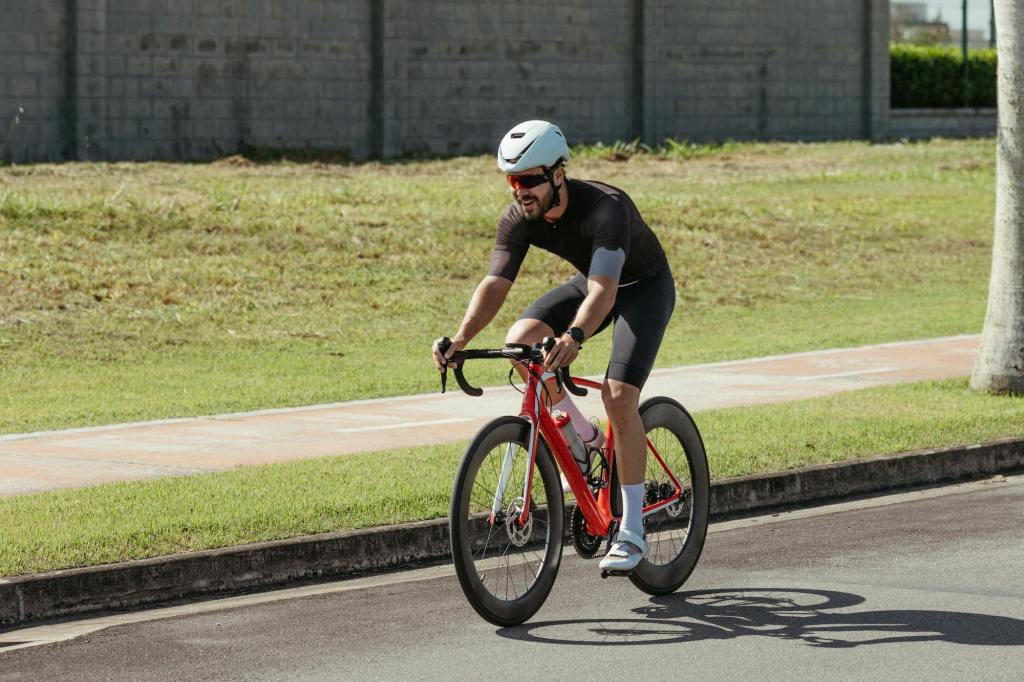
During the Giro d’Italia, Victor Campenaerts, a pro cyclist and all-round good lad, was asked about Jonas Vingegaard’s striking body hair and whether that,and for example having a beard or moustache, had any impact on riding. Part of his answer was something along the lines of this (note, I am paraphrasing here): “A little bit of hair can be aero-beneficial. I even tested it in the wind tunnel. Anything that does not make your face bigger does not matter. At first I had more of a beard, and that made me slower.”
The moustache, according to Campenaerts, was fine. The big beard was not. Now to be clear, he did not claim a huge difference. Just a measurable one.
I am not one who would question this Belgian cycling wunderkind, but I do wonder, how much of an impact does that beard really have? Not that it matters that much to me personally, since I am more like Vingegaard. Not in the athletic sense, but in the having-difficulty-growing-a-nice-beard sense.
Anyway, I still had to find out.
It turns out that, way back, Specialized, the bike brand, actually tested this in their wind tunnel. Their findings were that a beard adds roughly half a watt of drag at typical cycling speeds. Not zero, but not a catastrophic drag penalty either.
The reason it’s so small comes back to location. Your face, when you’re riding in any kind of aero position, is largely tucked behind part of your helmet, your arms, and your torso. It’s not the part of you doing the most damage to your aerodynamics. Your back, shoulders, and the gap between your body and the bike are where most of the drag occurs. The face is relatively sheltered and relatively small. Hair on it, even a full beard, is apparently not moving the needle much in real-world riding.
There is also a texture argument that occasionally surfaces. Just as rough fabric on a sock can help manage airflow around a cylindrical leg (notice for example how aero socks are in fact not smooth at all), facial hair can theoretically influence how air moves across the curved surface of a jaw and chin. Whether this meaningfully offsets any added drag is debatable, and the answer seems to be that the effect is too small to measure cleanly in most tests.
The verdict, based on what data exists: a beard is not a meaningful aerodynamic problem for most cyclists. Half a watt at race speed is real but sits well below the noise floor of position, kit fit, and tyre choice.
However, to come back to Campenaert’s point. A short beard may have virtually no measurable effect. A large, bushy beard indeed increases frontal area and changes airflow around the face. In aerodynamics, size matters more than almost anything else. If the beard makes your head effectively bigger, it can increase drag. Once again, at amateur level, the impact is pretty much zero.
Watt I Learned
If you are not selected for the Tour de France, your beard is fine. Half a watt is the kind of number that matters when everything else is already optimized to an elite level. For the rest of us, position and kit fit are worth hundreds of times more attention than facial hair. Keep the beard, ditch the flapping jersey.




Leave a Reply