

There are some cycling topics that are perfect for a long ride coffee stop. Not because they will change your life, but because they will immediately make everyone at the table lean forward and start arguing with a waffle in their hand (sorry, you can take the Belgian out of Belgium, but not the Belgium out of the Belgian..).
Drafting is one of those topics. We all know sitting behind someone is easier. That part is hopefully not news. The interesting bit is how much easier it gets, where in the line the biggest benefit is, and whether your body position still matters when you are already hiding from the wind.
Now, before we continue, dear Watters, before you continue reading, I added the hard scientific facts at the bottom of this article. However, as it is quite the heavy read, I have gone through the details myself, and to the best of my ability, am summarizing the findings here.
A relatively recent research paper, see below, looked exactly at this coffee-stop worthy topic: the aerodynamic impact of cycling posture on drafting in single paceline setups. In normal human speak, that means the researchers studied riders lined up one behind another, like you see in a group ride or team time trial, and probably on your Sunday ride with friends. They measured how much drag changes depending on where the rider sits in the line and what position they ride in.
The headline is simple and again, I hope, not surprising: drafting works a lot. Not “a little bit easier” a lot. Properly sitting in a paceline can cut drag massively. In the study, pacelines of up to eight riders were tested, and the biggest drag reduction found was 68% (come on, that is super impressive). That was for a rider in the second-to-last position of an eight-rider line, riding in a lower dropped position, compared with riding alone in a higher dropped position.
That is a huge number. It helps explain why group riding feels like cheating when the group is smooth, and why a drafting-legal race (I’m looking at you, Ironman people) is a completely different creature from a non-drafting race. In one, you are managing position, shelter, timing, and the group. In the other, you are paying your own air bill all day. That last point is also why you see so many TT bikes in Ironman races, because people tend to understand that, if there is no drafting, they can probably use all the help they can get from their bike position at the very least!
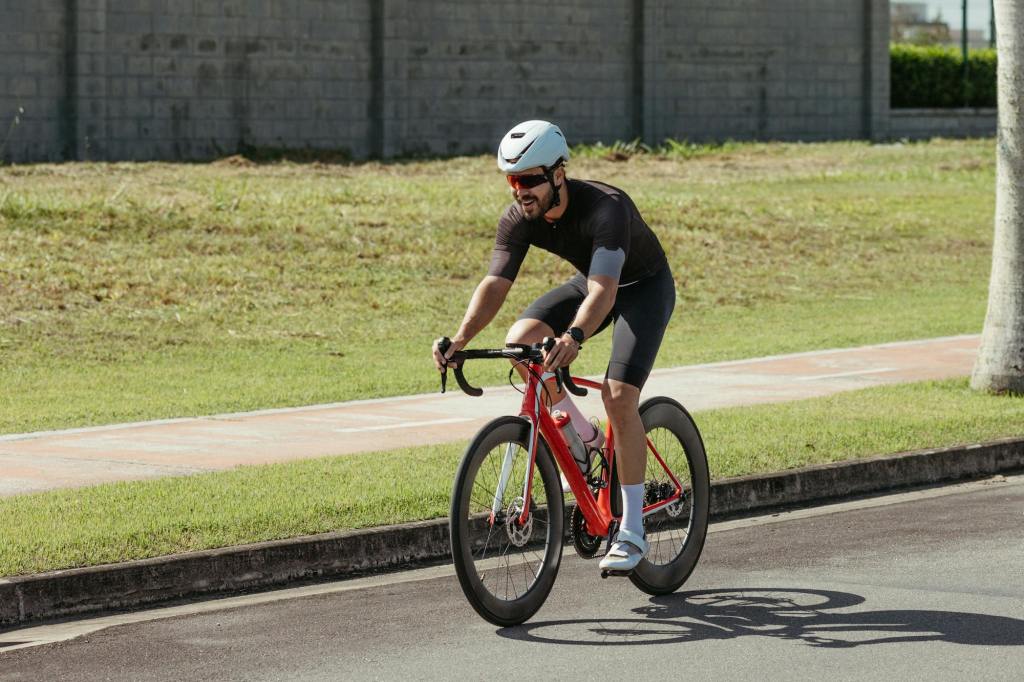
Back to the findings. The study looked at three riding postures. There was a higher dropped position, a lower dropped position, and a time-trial position. Unsurprisingly, riding lower and more aero helps when you are alone. The time-trial position had the lowest drag for an isolated rider, with a drag area of 0.213 m². The lower dropped position was next at 0.231 m², and the higher dropped position came in at 0.266 m². So yes, if you are riding solo, position matters. Quite a lot.
One practical number from the paper is worth remembering, and makes the findings also a bit more usable to us, mere mortals, trying to survive the Sunday ride to the best of our abilities. In a road-race type situation, simply moving from a higher dropped position to a lower dropped position reduced drag area by about 13% for a solo rider. That is just getting lower! Of course, the usual caveat applies: lower only helps if you can actually hold the position and still produce power. Looking aero for twelve heroic seconds before sitting up doesnt do much. That is why many endurane cyclists will suggest that you have a proper bike fit, so you can actually sit, and stay, in such a low position for a long time. If you are not comfortable, you simply will not stay down, and you will not stay aero.
Another fun part is what happens in the line.
For pacelines up to five riders, the last rider had the lowest drag (again, no susprise there I suppose). But the surprise to me was reading that once the line grows to six, seven, or eight riders, the lowest drag was not at the very back. It was the penultimate rider, which is just a fancy way of saying the one-but-last rider. So for the lucky few of you with that many friends,m maybe it is time to be more selective with the friends you bring on your Sunday ride! Sadly, “too many friends” is not a problem I have to deal with very often. Who is crying, I’m not crying..
That is a good coffee-stop fact. In a longer paceline, the easiest aerodynamic seat may not be last wheel, but second-last wheel. The researchers found this across the different postures they tested. The exact posture changed the drag values, but the position of minimum drag stayed the same. Up to five riders, last is best. From six to eight riders, second-last is best. I put it in bold, so the lazy eye scanning this article hopefully also catches this piece of information 🙂
Why though? The explanation is that the air behind a line of riders is messy, and that mess changes as the line gets longer. The wake grows as it travels through the group, roughly up to the fourth or fifth rider, and then it starts to level out. The rider at the very back is still sheltered, of course, but the airflow around the second-last rider in a longer line appears to hit the sweet spot of being deeply protected without sitting in quite the same rear-end wake structure as the final rider. That is a casual explanation, not a PhD defense, but it is enough to make the point: the air behind a group is not just “less wind.” It has shape?
The study also found that posture still matters, even when drafting. It matters less than when riding alone, but it still matters. Riding lower reduces your own drag, and riding in the right place in the line reduces it even more.
More numbers for the data nerds reading this: For an eight-rider paceline, the maximum drag reductions in the sheltered positions were around 60% or more, depending on posture. The average drag area across the eight-rider line was also heavily reduced, down to roughly half of the solo situation.
Knowing all this, be kind to eachother on Sunday rides ok, this is why taking turns matters if the ride is meant to be cooperative, and why sitting in all day before sprinting for the town sign remains one of cycling’s oldest crimes against friendship.
If you are alone, get comfortably lower if you can hold it. If you are in a group, learn to ride smoothly and stay close enough to benefit without doing anything sketchy. If the paceline is longer, understand that the middle-to-back part of the line is where the air bill gets cheaper.
Aerodynamics is not only about expensive kit. Yes, frames, wheels, helmets, and clothing matter. But where you put your body and where you sit in the line can dwarf a lot of those upgrades. A lower posture alone gave a meaningful reduction when riding solo. A good drafting position in a longer line gave a massive reduction.
Watt I’ve Learned
Drafting is not just “a bit easier.” In measured data, it can be the difference between doing nearly all the work and doing dramatically less of it. The study’s most quirky finding is that in longer pacelines, the easiest spot was not always last wheel, but often second-last wheel. Posture still matters, too: getting lower helps when you are solo and still helps when you are sheltered.
Ride smooth, stay safe, stay sheltered, and remember that in a drafting event, position is power. In a non-drafting event, there is nowhere to hide.
Source
Malizia, F., Blocken, B., van Druenen, T., van Hooff, T., & Tummers, M. J. “Aerodynamic impact of cycling postures on drafting in single paceline configurations.” 2023.


Leave a Reply